

The costliest mistakes in managed print agreements hide in plain sight: evergreen renewal clauses, uncapped per-page escalators, minimum volume floors you’ll never hit, blended rates that mask device-level overcharges, weak SLA remedies, and end-of-lease data security gaps. Before you sign anything, pull a substantial period of actual device usage data and demand an all-in cost quote at those real volumes, not the vendor’s estimate.
Australian Consumer Law and the Australian Competition and Consumer Commission (ACCC) already protect small businesses from unfair terms in standard form contracts, and the Privacy Act 1988 sets baseline obligations for how customer and business data on those devices gets handled. Here’s what to watch for:
- Evergreen or auto-renewal clauses that can be difficult to exit
- Hidden fees buried in schedules, not the main terms
- Minimum monthly volume commitments you’ll never use
- Price escalators without objective or capped limits
- Vague service level agreements with no financial teeth
- Data security gaps at end of lease
- End-of-term buyout and de-installation surprises
Key Takeaways
Avoiding print management contract pitfalls requires pulling real usage data, capping escalators to CPI, and demanding device-level cost transparency before signing anything.
| Point | Details |
|---|---|
| Pull usage data first | Gather 12 to 24 months of device-level usage before requesting any new quote. |
| Cap escalators | Insist on CPI-tied price increases with a hard percentage cap, not open-ended market adjustments. |
| Demand device-level reporting | Reject blended fleet rates that hide which specific machines cost the most to run. |
| Secure data at lease end | Require certified wipes, encrypted drives, and documented chain of custody for every device. |
| Review contracts regularly | Independent audits often reveal businesses overpaying by 18 to 37 percent on unreviewed agreements. |
| Consider an authorised dealer | Global Office Machines offers device-level transparency and managed print services as an alternative to opaque blended contracts. |
Table of Contents
- Common print management contract pitfalls explained
- Contract clauses to check in detail
- How do you calculate the real cost of a print contract?
- Data security, privacy and end-of-lease sanitisation
- Service levels, response times and remedies that protect uptime
- End-of-term, transitions and ownership traps
- Practical negotiation checklist and questions to ask suppliers
- How Global Office Machines addresses these contract pitfalls
- Intellectual property rights and license terms related to software
- Confidentiality and data privacy obligations beyond hard drive sanitisation
- Flexibility for scaling services up or down during contract term
Common print management contract pitfalls explained
Print management contracts read simply until you hit the fine print, and that’s exactly where the trouble lives.
- Evergreen clauses. These auto-renew the contract for another full term unless you cancel within a narrow window, often a narrow window before expiry. Miss it, and you’re locked in again.
- Hidden line items. Delivery fees, “environmental levies,” or software licensing charges sit outside the headline price and inflate the real bill.
- Minimum monthly volumes. You pay for a page count whether you print it or not. If your office went hybrid and volumes dropped, you’re still funding the old baseline.
- Blended vs device rates. A single average per-page rate across a fleet hides which machines are bleeding you dry. One workgroup printer might cost triple another to run, and you’d never know.
- Supply carve-outs. Some contracts exclude specialty toner, drums, or maintenance kits from the “inclusive” price, then bill them separately at inflated rates.
- Escalator risk. Annual price increases without a cap compound over a typical a multi-year term until the per-page rate barely resembles what you signed up for.
Contract clauses to check in detail
Read the lease and the service agreement as two separate documents, because most managed print deals bundle them and vendors don’t always volunteer both in full before signing.
- Lease/service split. Insist on seeing the finance lease terms separately from the service schedule. Buried finance obligations often survive even if you terminate the service side.
- Escalator wording. Push for a clause tied to the Consumer Price Index with a hard percentage cap, not an open-ended “market rate adjustment” the vendor controls unilaterally.
- Termination for cause. The contract should spell out what counts as a breach (missed SLA response times, repeated equipment failure) and what exit costs apply if you invoke it.
- Audit and meter-reading rights. You should be able to request independent meter reads and usage reports at any time, not just what the vendor chooses to disclose.
- Assignment clauses. Check whether the vendor can transfer your contract to a third party without your consent, which can quietly change your service quality overnight.
- Warranty support. Confirm parts and labour warranty terms survive any assignment or business sale on the vendor’s side.
Legal analysis of managed print contracts consistently flags minimum volumes, uncapped escalators, and poor device-level transparency as the three traps doing the most financial damage.
How do you calculate the real cost of a print contract?
Total cost of ownership only becomes visible once you convert every quote into the same comparable, all-in figure.
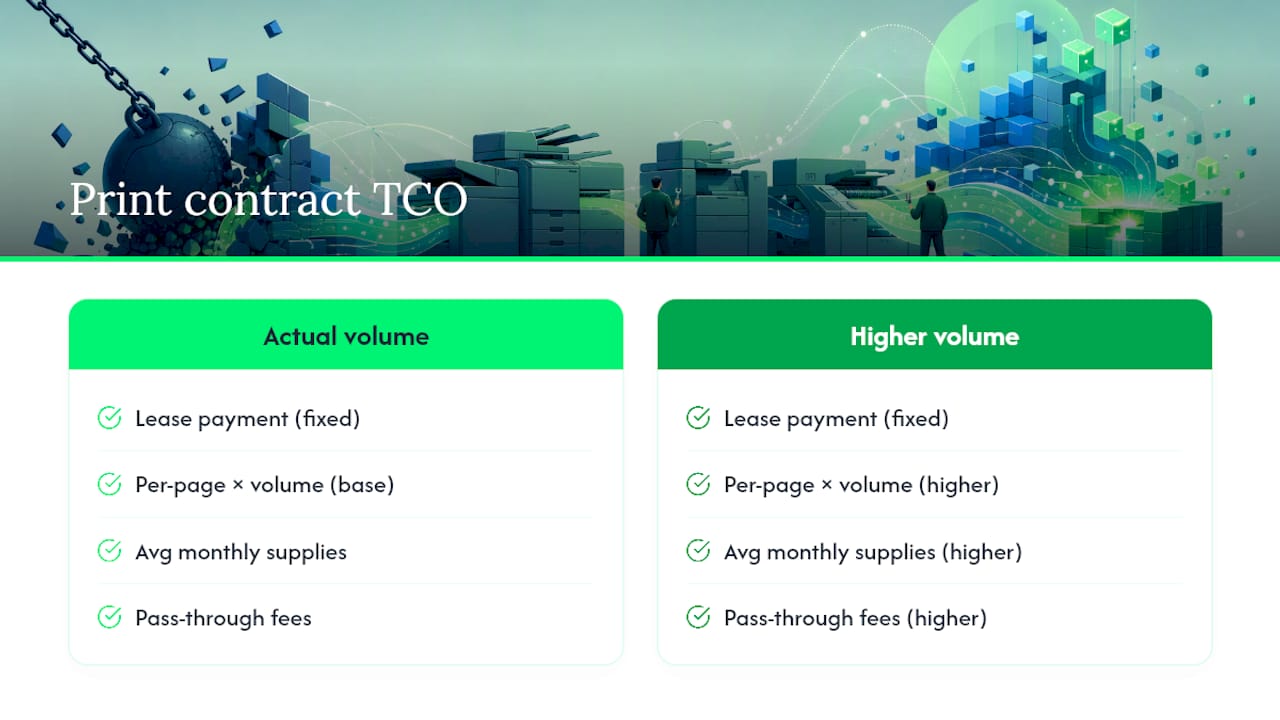
Start by pulling 12 to 24 months of usage data by device and department, ideally from your current provider’s own meter logs. Then apply this formula: lease payment, plus (per-page rate multiplied by expected monthly volume), plus average monthly supply costs, plus any pass-through fees like delivery or environmental levies. Run the number twice, once at your actual historical volume and once at a plausible higher volume, to see how exposed you are to overage charges.
Colour pages typically cost 5 to 10 times more than black and white per print, so a handful of accidental colour jobs can quietly wreck a monthly budget. Device-level transparency matters because blended fleet rates hide which machines are actually costing you.
Pro Tip: Ask every vendor to quote per device, not per fleet. If they resist, that reluctance alone tells you the blended rate is hiding something.
Data security, privacy and end-of-lease sanitisation
Every managed print device with a hard drive stores scanned documents, print jobs, and sometimes network credentials, which makes it a genuine target. Security researchers have found large numbers of networked printers exposed to attack, with some incidents involving thousands of compromised devices used to extract stored files.
Your contract should require:
- Encrypted drives (TPM or self-encrypting drive standard) on every networked device
- Certified data wipes performed and documented at end of lease, not just promised verbally
- A written chain of custody for any device leaving your premises
- Clear ownership of print usage data, with exportable reports available on request, not locked inside vendor-only software
The Privacy Act 1988 places obligations on how businesses handle personal information, and a print fleet holding scanned invoices, HR documents, or client files falls squarely within that scope. If your vendor can’t document their sanitisation process in writing, treat that as a red flag, not an oversight.
Service levels, response times and remedies that protect uptime
A service level agreement (SLA) without financial teeth is just a suggestion. Make it enforceable:
- Specify response windows in hours (four hours for critical devices, next business day for standard ones), not vague terms like “prompt service.”
- Require dollar-denominated SLA credits for missed windows, not a generic promise to “make it right.”
- List exactly which parts and consumables are covered under the service fee versus billed separately.
- Require quarterly business reviews with a named account manager, not a rotating call centre queue.
- For mission-critical devices, demand a guaranteed loaner unit if repair exceeds a set number of hours.
Weak agreements fail on exactly these points. Industry guidance on copier service contracts points to vague response windows and unclear parts coverage as the most common reason service contracts stop protecting the business that signed them.
End-of-term, transitions and ownership traps
The final months of a print contract are where unexpected invoices tend to surface. Before signing, clarify whether the equipment ends on Fair Market Value (FMV) terms or a $1 buyout, and get a written estimate of the buyout figure well ahead of expiry rather than discovering it in the last quarter.
- Require a 30 to 90 day transition assistance period where the outgoing provider maintains basic supply and monitoring while a new provider installs replacement agents
- Confirm data and usage export rights survive contract termination
- Get de-installation costs and timelines in writing, including who pays if removal is delayed
A practical transition clause with genuine overlap between outgoing and incoming providers prevents the common gap where consumables and monitoring simply stop the day the old contract ends.
Practical negotiation checklist and questions to ask suppliers
Before you sign, get written answers to these:
- What’s the minimum monthly volume, and what happens if we fall short?
- Is the escalator capped, and tied to what index?
- Which supplies are included versus billed separately?
- Can we get device-level, not blended, cost reporting?
- What are the audit rights, and how often can we request meter reads?
- What SLA credits apply for missed response windows?
- Is there a written buyout estimate for end of term?
- What’s the transition assistance period if we switch providers?
- Can the contract be assigned to a third party without our consent?
- What certified data wipe process applies at lease end?
Red flags that should trigger legal review: refusal to itemise device-level costs, resistance to capping escalators, and any clause that auto-renews without a clear, generous notice window.
Pro Tip: Propose a simple edit: replace “market-based price adjustment” with “CPI-indexed adjustment, capped at 3% annually.” That single change limits years of compounding risk.
How Global Office Machines addresses these contract pitfalls
Global Office Machines is an authorised dealer for HP, Kyocera, Fuji Xerox, Lexmark, and other major brands, with managed print services built around the transparency this guide recommends.
- Device-level cost reporting rather than blended fleet averages
- Genuine, authorised consumables with no unexplained carve-outs
- Certified data wipe documentation at lease end
- A named account manager instead of a rotating support queue
- National footprint across NSW, VIC, QLD, WA, and SA
Intellectual property rights and license terms related to software
Managed print contracts almost always bundle proprietary fleet management software, and the licensing terms attached to it deserve as much scrutiny as the hardware lease. Most vendors license this monitoring and print-management software rather than sell it outright, which means your right to use it typically ends the moment the service contract ends, even if you’re mid renewal negotiation with a new provider.
Check whether the licence is tied to the specific hardware or to your organisation. Hardware-tied licences can force you to pay again for functionally identical software if you swap devices mid-term, which erodes any savings from a mid-contract hardware refresh. Also confirm who owns the configuration data and print rules you build inside that software over the life of the contract, things like department billing codes, user permissions, and automated workflows. Losing that configuration at contract end means rebuilding it from scratch with a new provider.
Watch for clauses granting the vendor broad rights over any custom integrations or reporting templates developed during the engagement. If your IT team builds a custom dashboard or automated reporting rule set on top of the vendor’s platform, the contract should state plainly that your organisation retains rights to that work product, not just the vendor’s underlying software. Ambiguous IP clauses here rarely cause problems on day one, but they become expensive when you try to leave.
Confidentiality and data privacy obligations beyond hard drive sanitisation
Certified data wipes at end of lease cover the hardware, but confidentiality obligations should extend well beyond that single moment. Every managed print provider’s staff and remote monitoring systems potentially see metadata about what your business prints, how often, and from which department, even without accessing document content itself.

Your contract should specify who at the vendor’s organisation can access print logs and usage analytics, and under what circumstances. If the vendor uses subcontractors for maintenance or remote monitoring, confirm those subcontractors are bound by the same confidentiality terms, not a separate, weaker agreement you’ve never seen.
Data residency also matters more than most procurement teams initially assume. If usage data or print job metadata is processed or stored on servers outside Australia, that has implications under the Privacy Act 1988, particularly for businesses handling client records, health information, or financial documents. Ask directly where data is hosted and processed, and get that answer in writing rather than relying on a verbal assurance during the sales process.
Finally, confirm what happens to confidentiality obligations after the contract ends. A well-drafted agreement keeps the vendor bound to confidentiality for a defined period post-termination, typically two to three years, covering any data or business information they were exposed to during the engagement.
Flexibility for scaling services up or down during contract term
Business needs change over a three to five year contract term, and a rigid agreement that can’t flex with headcount, office consolidation, or hybrid work shifts becomes a liability rather than a tool.
Look for a contract that allows device additions or removals at defined intervals, quarterly or biannually, without triggering a full renegotiation or penalty fee. If your organisation is growing, confirm the pricing for additional devices is locked in at the original per-page rate, not renegotiated at a premium once you’re already committed. If you’re downsizing, check whether removing a device early counts as an early termination event with penalty fees attached, even when the rest of the fleet stays under contract.

Seasonal businesses and those with fluctuating print volumes should also negotiate a volume band rather than a fixed monthly minimum, allowing usage to flex within an agreed range without penalty. This matters more than it seems: many of the minimum volume traps described earlier stem from contracts signed during a high-usage period that never accounted for future change.
Ask specifically whether the contract permits mid-term device swaps, upgrading an underused colour multifunction printer to a simpler black and white unit, for instance, without resetting the clock on your existing term. Vendors who resist this kind of flexibility are usually protecting a pricing structure that depends on you staying locked into an outdated fleet configuration.
Why independent audits matter more than vendors admit
Most negotiation pitfalls trace back to one thing: businesses accept the vendor’s estimate of their own usage instead of pulling their own data. An early usage export changes the entire negotiation. Start there before you talk numbers with anyone.
Get a usage audit before your next print contract renewal
There are other ways to approach a print contract review, a generic finance broker, a DIY spreadsheet audit, or simply accepting the incumbent vendor’s renewal terms. None of them give you device-level cost data from a team that also sells and services the hardware itself. Global Office Machines is an authorised dealer for HP, Kyocera, Fuji Xerox, and other major brands, which means a contract review comes from people who know exactly what a fair per-page rate and service response time should look like for your actual fleet.
If you’re heading into a renewal or a first-time managed print agreement, start with a device audit rather than a vendor’s quote. Browse the HP Colour LaserJet Managed E77830Z as an example of a transparent, device-level managed offering, or reach out for a usage audit and contract review before you sign anything new.